Parallel Systems: Part 2 - Payments and Financial Infrastructure

As a child, I remember the small ritual before we travelled.
My father would take out a worn black leather travel wallet - always the same one - and carefully prepare it for the journey south. Inside, three currencies lay side by side: Swedish kronor, Danish kroner, and German Deutsche Mark.
Cash for a short trip.
Three systems in one hand.
We were driving to my grandmother, Anna, in Diepholz.
At the time, it felt practical. Necessary, even.
Crossing borders meant crossing systems - each with its own rules, its own money, its own logic.
Looking back, it was something more.
A small, tangible reminder that Europe was not yet one system -
but many, overlapping.
But the post World War two financial system was not designed for fragmentation.
It was designed to optimize for speed, liquidity, and trust within an increasingly integrated, dollar-centric order.
For decades, it evolved toward integration.
Not through a single authority, but through convergence.
Standards aligned.
Networks connected.
Trust accumulated.
What emerged was not a global financial system by design -
but one in practice.
At its center stood a set of infrastructures that enabled this integration:
correspondent banking networks, dollar clearing, and messaging systems such as SWIFT.
This system did not eliminate sovereignty.
But it made sovereignty conditional.
Access became the foundation of participation.
Few states or corporations had the courage or the necessary resources to stand outside it - and those who tried rarely did so without consequence.
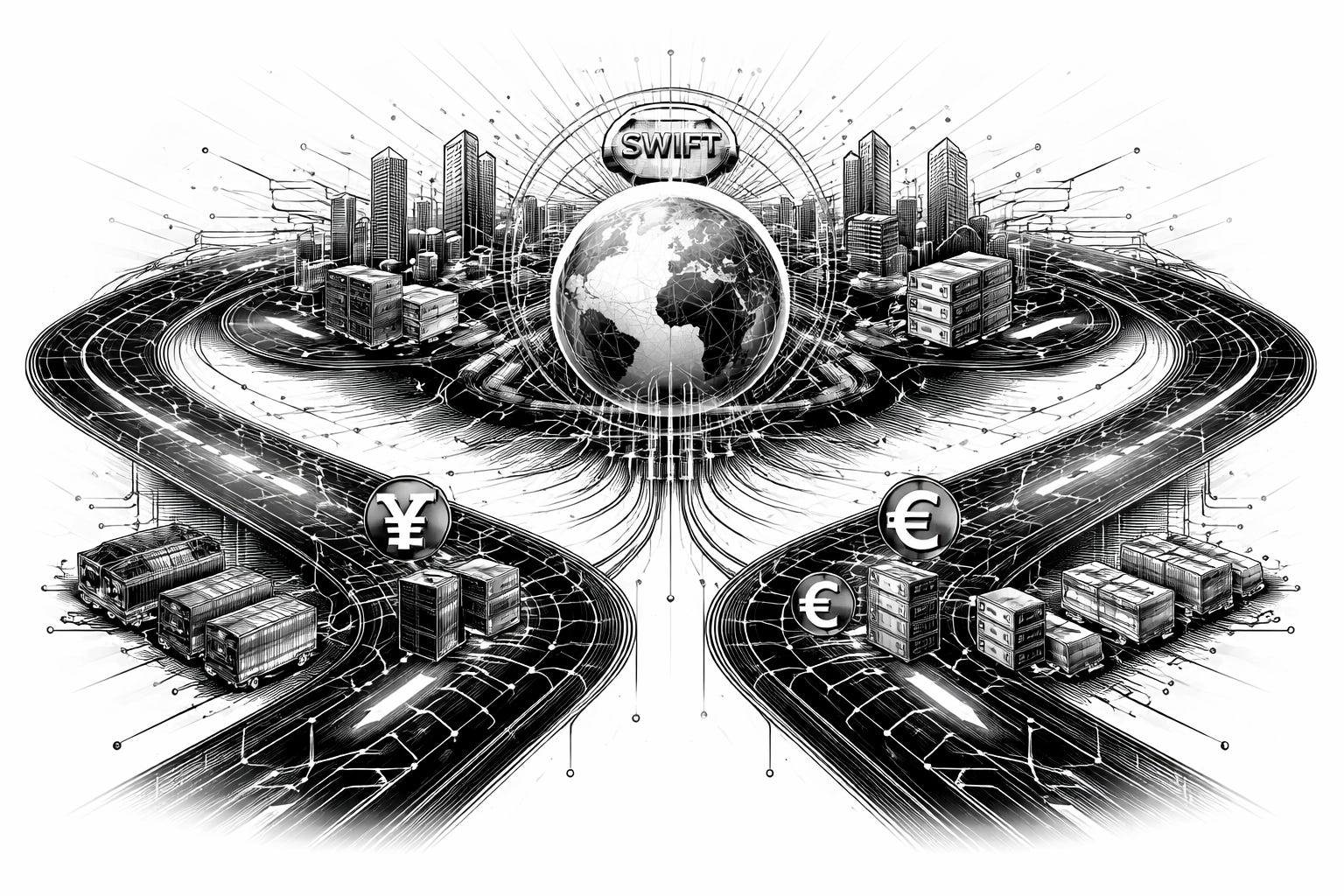
Before the Transition
Before the current phase of today, the logic was clear:
More integration meant more efficiency.
More connectivity meant more growth.
Cross-border payments became faster.
Liquidity became deeper.
Capital moved with fewer frictions.
The system was not fully neutral.
But it was widely accepted as the default.
Participation was not a geopolitical choice.
It was an economic necessity.
What Is Changing
That assumption no longer holds.
The financial system is not fragmenting randomly.
It is being recalibrated.
Sanctions have maybe been the most visible driver.
But they are not the only one.
What sanctions revealed is structural, not episodic:
Control over financial infrastructure can be weaponized.
Access can be restricted.
Transactions can be blocked.
Reserves can be immobilized.
Not as theory -
but as demonstrated capability.
It does not break the system – it reveals its politicized nature.
From neutral infrastructure -
to strategic dependency.
Parallel Systems Emerging
The result is not immediate separation.
It is duplication.
Systems that once appeared singular are now being mirrored.
SWIFT continues (for the time being at least) to dominate global messaging
But alternatives such as CIPS have expanded, particularly in cross-border RMB transactions and among institutions seeking optionality -
not equivalence, but optionality.
Dollar clearing remains central.
But settlement paths are diversifying.
Bilateral arrangements increase.
Local currency settlements expand.
Regional mechanisms are tested.
Not as replacements -
but as hedges.
Not exit.
But redundancy.
Redundancy that, over time, creates its own gravity.
Alternative Pathways (Outside the System)
Alongside parallel state-backed systems, attempts have also been made to operate outside traditional financial infrastructure altogether.
Cryptocurrencies such as Bitcoin represent one such pathway.
However, rather than forming a parallel system, they function as a partial escape mechanism:
• limited in scale
• volatile in value
• dependent on entry and exit points connected to the existing system
As a result, they do not replace financial infrastructure.
They exist at its margins -
as an alternative, but not as a system.
Where Incompatibility Appears
At first, parallel systems coexist.
Over time, they diverge.
Standards begin to differ.
Legal frameworks evolve separately.
Access conditions tighten.
What was once interoperable becomes conditional.
A transaction that clears in one system may not clear in another.
A counterparty acceptable in one jurisdiction becomes restricted in another.
The same payment instruction -
routed through different systems -
can produce different outcomes.
These are not technical failures.
They are structural outcomes.
Decision Logic in Practice
This is where selective compatibility becomes operational.
As outlined in Part 1 of this series on parallel systems, actors are moving from maximizing integration toward managing exposure through selective compatibility.
Actors are no longer asking:
“How do we maximize access?”
They are asking:
“Where can we afford exposure?”
The decision logic follows a pattern:
• Connect where liquidity and scale outweigh risk
• Restrict where exposure creates vulnerability
• Replace where dependency becomes untenable
In practice, this is determined by:
• Value versus risk exposure
• Substitution lead time and cost
• Regulatory and sanctions exposure
• Strategic criticality
The result is not uniform behavior.
It is differentiated positioning.
Direction of Travel (3–5 Years)
The system is not splitting in two.
It is thickening.
